Most weak hooks are not too quiet. They are too vague.
"Here are three lessons I learned..." is not a bad sentence because it lacks hype. It is bad because the reader has no clue why these lessons are different from the thousand other lessons currently scrolling past them. The line could open anyone's post about anything. That is the problem.
A better hook does not need to trick anyone. It needs to create a clean reason to keep reading.
What I actually recommend
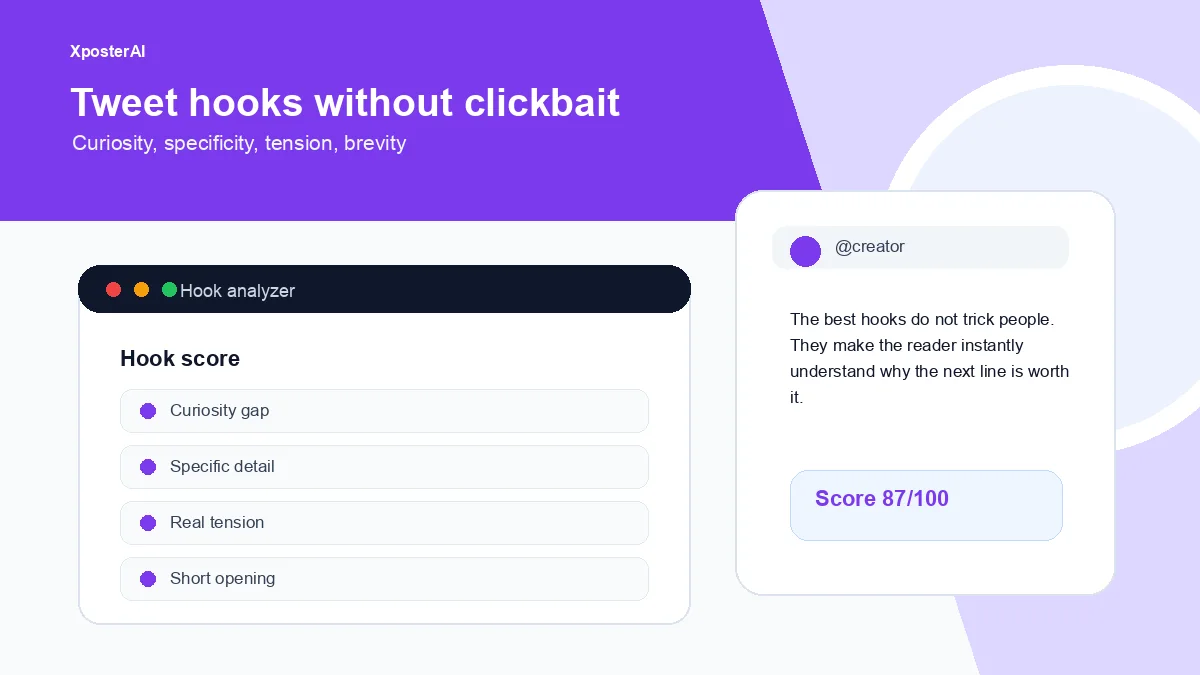
Write a first line that is specific, short, and unfinished in a useful way. It should tell the reader what kind of payoff is coming without handing the whole payoff over in line one. The Tweet Hook Analyzer scores curiosity, specificity, tension, and brevity — useful as a second pass, useless as a starting point. A tool can sharpen taste. It cannot supply it.
Four jobs your first line has
Your first line is doing more than introducing the topic.
It has to stop the scroll, frame the idea, qualify the reader, and create a reason to continue. That is why generic hooks feel weak. They try to do the first job and ignore the other three.
| Hook job | Weak version | Stronger version |
|---|---|---|
| Stop the scroll | I learned a marketing lesson | I spent $4,200 on marketing advice. The best lesson was free. |
| Frame the idea | Let's talk about bios | Your X bio is probably not too short. It is too hard to trust. |
| Qualify the reader | For creators | If your posts get profile clicks but no follows, check this first. |
| Earn the next line | Thread below | The mistake usually happens before you write the post. |
Hooks that feel strong without feeling cheap
Good hooks usually contain one of these ingredients:
- A number with context: "I rewrote 37 creator bios. The same leak showed up in 29."
- A useful contradiction: "The best hook is not always the loudest line."
- A painful diagnosis: "Your profile is not losing people at the link. It is losing them at the promise."
- A specific mistake: "Most creators split threads too late. The outline was broken first."
- A tiny story: "I almost deleted a post that later became the clearest product positioning note I had."
None of these require fake urgency. They work because they make the reader curious about a real thing.
Before and after
Weak: Tips for getting more followers on X.
Better: Your X profile can get visits and still leak follows. Here are the first three places I would check.
Weak: I made a free tool.
Better: I built a tiny free tool for the part of posting on X that still feels weirdly manual: cleaning ugly links.
Weak: How to write better threads.
Better: A thread splitter fixes length. It does not fix a thread with no argument.
The editing pass I use
Write the honest first line first. Then ask: what is the specific tension here?
If the line is "I made a content calendar," the tension might be "most calendars fail because they assume a perfect week." That becomes a better hook.
If the line is "I made a bio generator," the tension might be "most bios describe the creator but do not help the visitor decide." That becomes the angle.
If the line is "I made a reply tool," the tension might be "a reply is a public first impression under someone else's distribution." Now the post has stakes.
The honest first line is almost never the published first line. It is the raw material. The published first line is what you write after you find the tension.
Sharpen the hook before posting
Use the Tweet Hook Analyzer after you have a real angle, not before. Tools are better at sharpening than inventing taste. If the idea is a thread, build the sequence in the Thread Outline Builder, then improve the first line last. For longer thread momentum, use the Thread Cliffhanger Generator.
FAQ
Are curiosity gaps clickbait?
Only when the payoff does not match the promise. "You won't believe what happened next" is clickbait because the answer is almost always "something fairly mundane." "The mistake usually happens before you write the post" is a curiosity gap because there is a real, specific answer waiting on line two. The honest test: if the rest of the post delivers, the gap was earned. If you find yourself stretching the body to justify the hook, the hook was a bluff.
How long should a tweet hook be?
Usually one short sentence. If the first line needs a second line to make sense, it may be setup, not a hook.
Should I use viral hook templates?
Use them to study structure, not to copy language. Reused hook phrasing makes your account sound rented.