Replies look small in the interface, so creators treat them like throwaways.
That is a mistake. A reply sits under someone else's distribution, next to other people trying to be seen, in front of readers who may have never heard of you. It is one of the cheapest first impressions you get on X — and the one most creators waste with "this."
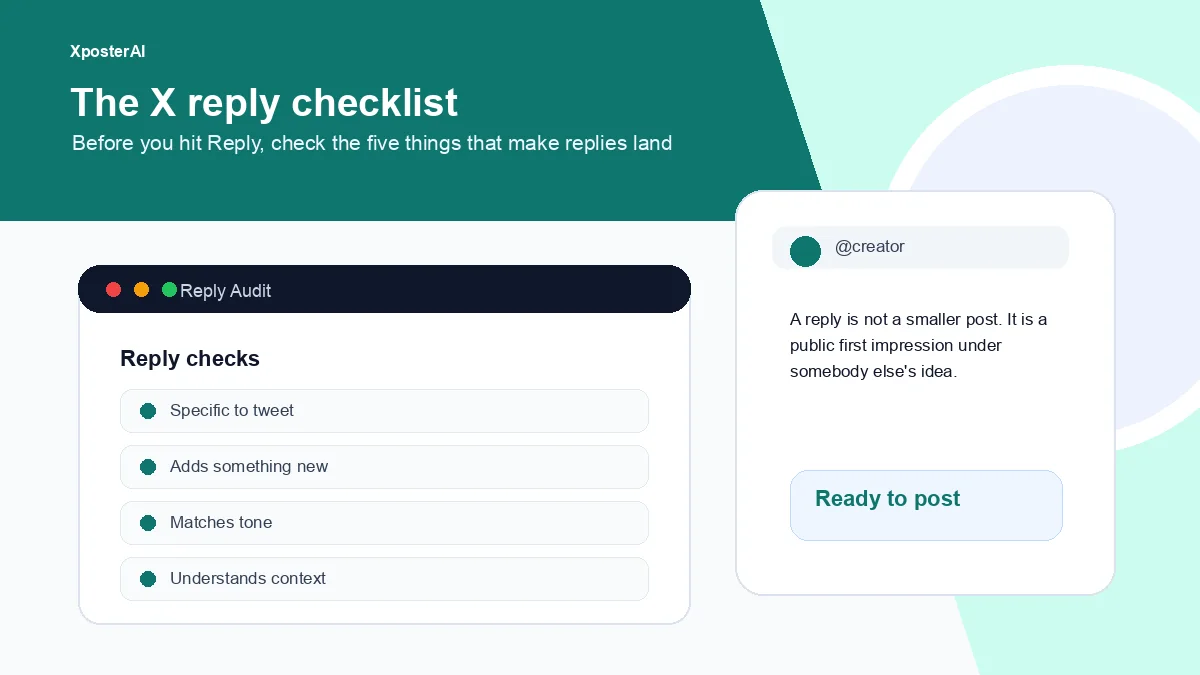
Before you hit Reply, run five checks: is it specific to the original post, does it add something new, does the tone fit the room, is it short enough to scan, and would a profile click make sense after reading it? The Reply Audit tool catches weak drafts, and the XposterAI Chrome extension helps when you are replying inside X.
The five checks
1. Specific: Could this reply sit under any tweet? If yes, it is too generic.
2. Additive: Does it add an example, useful disagreement, sharper wording, or a next step?
3. Tone-fit: Does it match the original post's energy? A joke under a serious post can feel tone-deaf. A corporate reply under a casual post can feel automated.
4. Concise: Can the reader get it in one glance? Replies die when they require too much context.
5. Profile-aligned: Does it reinforce what you want to be known for?
A real before and after
Original tweet: Most creators do not have a content problem. They have a positioning problem.
Weak reply: So true. This is important.
That reply is harmless, but it gives nobody a reason to remember you.
Better reply: The painful version: they keep changing topics because no single topic is attached to a clear audience yet. A calendar helps after the positioning is stable.
This works because it adds a diagnosis. It also quietly connects to content planning without hijacking the original post.
Replies that usually underperform
Praise-only replies are the first category. "Great point" is polite, but it does not create a trail back to your account.
Pitch replies are the second. If the first move is your link, the reply stops feeling like participation and starts feeling like extraction.
Generic AI replies are the third. "This resonates." "Great insights." "Such a banger." These don't sound like a person with a point of view. They sound like a placeholder. The tell is that you could lift the same sentence and paste it under five unrelated posts in the same hour and nothing would feel off.
A better reply menu
When you are stuck, choose one of these moves:
- Add a concrete example from your own work.
- Name the hidden tradeoff in the original post.
- Agree, then make the point more specific.
- Disagree with one part while respecting the main idea.
- Offer a useful next step.
- Translate the idea into a checklist.
That gives you more range than "agree" or "argue."
Tools for the reply pass
Use Reply Audit for replies that matter. Use the free reply generator when you need a starting point. Use the Chrome extension when you want variants, tone control, and in-context drafting without copying the tweet into another tab. For deeper background, read how to write better X replies with AI and ChatGPT vs a dedicated X reply generator.
FAQ
Should every reply be polished?
No, and trying to is how creators burn out by Thursday. The rough split I use: most replies to peers and friends can be casual one-liners. Replies under large accounts in my niche, under prospects' posts, or under any thread I'd want a stranger to read — those get the five-check pass. Maybe one in ten replies on a busy day. The rest are just conversation.
Should I use AI for replies?
Use it for drafts and variants. Always edit for context, accuracy, and your actual voice.
How long should a good reply be?
Long enough to add something. Short enough that it does not feel like you are trying to take over the original post.