Most indie hackers spend 90% of their X time writing original posts and 10% replying. The growth math now says you have it backwards.
Public reporting on X's 2026 ranking weights puts a solo reply at 27x the weight of a like, and a reply that earns an author-reply back — a real two-turn conversation — at roughly 150x. The 150x is the headline number for a reason: it's the signal the ranker treats as proof your reply was worth replying to. Even the floor case (27x without an author response) is dozens of likes worth of signal, sent into the feed of someone whose audience is already paying attention.
That's the math nobody runs. A thoughtful reply on a 100K-follower post, in the first 30 minutes, will out-reach most of your original tweets on most days. Not sometimes — most days.
The 70/30 reply rule is the workflow built around that fact.
The 70/30 rule in three sentences
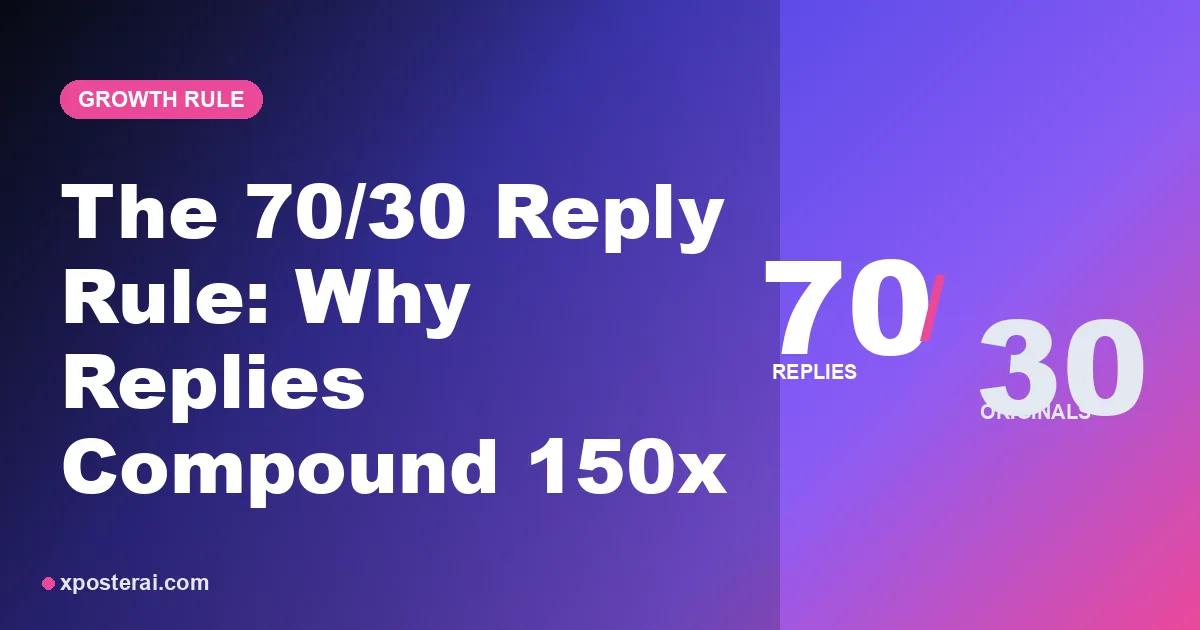
Spend 70% of your X time replying to other people in your niche, and 30% on your own original posts. On a 45-minute day, that's 30 minutes of replies and 15 minutes of originals — capped at one original tweet so perfectionism on a thread nobody asked for can't eat the reply budget.
The rest of this post is why it works and how to run it without sliding into reply-guy spam.
Why replies compound (four mechanisms, not one)
The 150x figure (and the 27x floor) isn't the whole story. The reply advantage is really four overlapping things stacking together.
Warm reach. When you reply to a post from someone with a real audience, your reply gets shown to a slice of their followers — people who already opted in to that topic. Your original tweet has to win cold attention; your reply lands in an already-warm room.
Algorithm reward. Per public reporting on the 2026 ranker, a solo reply is weighted 27x a like, and a reply that the author replies back to is weighted ~150x. The exact multipliers shift over time and across the ranker's segments — directionally, the lift is enormous.
Profile-click conversion. A good reply pulls click-throughs from people who arrived primed. They saw you say something useful in a conversation they were already in. That's a different visitor than the one who clicks from a cold viral tweet — they convert to follow at a meaningfully higher rate.
Network effect. When you reply consistently to the same 20-30 accounts, eventually those accounts notice. Some reply back. Once that happens, future replies of yours on their posts get more reach because the algorithm reads the relationship as real.
The daily 70/30 workflow
You need a target list. Without one, the workflow collapses into scrolling.
Build a private X List with 20-30 accounts in your niche. Mix the sizes — five very large accounts (100K+), ten mid-sized (10K-100K), and the rest peers in your range. The large accounts give you warm reach when you land a good reply early. The mid-sized accounts are the ones most likely to reply back. Peers are for the network effect over months.
Then run this pattern daily:
- Open the List first, not the home feed. The home feed is for consuming; the List is for working.
- Spend 30 minutes on replies. Aim for 4-8 substantive replies, not 20 quick ones.
- Reply early. The first 30 minutes after a post are when its reach is widest, which means your reply rides the same wave. A reply added six hours late will be seen by almost nobody.
- Spend 15 minutes on one original post. One. Not three. Not a thread unless you've actually got something to say.
- Check back two hours later for follow-up replies in your own threads. Conversations that you keep going get more reach than ones you abandon.
That's the loop. It's boring on purpose.
The four reply types that compound
Volume without quality is the failure mode here. These are the four shapes of reply that consistently earn profile visits and follow-backs.
The substantive addition. You add a data point, a counterexample, an edge case, or a relevant link the original post missed. Pattern: "One thing this leaves out — [specific detail]. In my experience [concrete example]." This is the highest-leverage reply type if you actually have the domain knowledge.
The personal experience that bridges. You ground the abstract claim in something you've actually lived through. Pattern: "Ran into this exact thing last quarter. [Specific situation], and [what you learned]." Personal experience is hard for bots to fake, and the algorithm seems to know it.
The contrarian-but-respectful pushback. You disagree with the idea, not the person, and you bring a reason. Pattern: "I'd push back on [specific point]. [Reason]. Curious how you'd handle [edge case]." This one is risky if you do it badly — the trick is disagreeing about substance, never about the poster.
The follow-up question that opens conversation. You ask the question that the comments section actually wants answered. Pattern: "This raises the question — [specific follow-up]. Have you found [X] works better than [Y]?" Done well, the original poster replies, which puts the whole thread back in feed.
For first drafts that follow these shapes, the Twitter Reply Generator is faster than starting from a blank box, and the Twitter Reply Audit will tell you if the draft you have is actually substantive or just polite filler.
The four reply types that get demoted
The other side of the math: bad replies aren't free. They actively cost you ranking signal, because the 2026 algorithm — including the Grok layer that evaluates reply quality on substance, novelty, and on-topic-ness — penalizes the patterns below.
"Great point!" / "Agree" / "This." These are zero-information replies. They look like engagement to humans and like spam to the ranker. If you don't have something to add, don't reply.
Engagement bait. "Comment YES if you agree." "Tag someone who needs to see this." The algorithm has spent two years training against this exact pattern. It demotes the post and, by association, the account.
Off-topic self-promotion. Dropping your product link under someone else's launch post is not a growth tactic. It's a brand-damage tactic. The host notices, their followers notice, and the algorithm reads the off-topic signal cleanly.
LLM-perfect formatting that screams bot. Em-dashes everywhere, the "It's not X, it's Y" rhetorical move, perfectly balanced three-bullet replies, the word "delve." The Grok-side ranker is getting better at flagging these patterns as low-novelty filler. If you want the longer breakdown of which tells get flagged hardest, AI pattern giveaways the Grok algo penalizes covers it in detail. The short version: edit the AI tells out before you post, or your reply gets buried whether or not the content is good.
The XposterAI workflow for this
To run 70/30 without burning out on friction:
- Use the Twitter Reply Generator when you have an opinion but the wording isn't landing. Generate two options, pick the better start, edit hard.
- Run the draft through Twitter Reply Audit — it flags generic filler, off-topic detours, and AI tells that get demoted.
- If the tone is close but not quite you, the Tone Rewriter shifts register without rewriting from scratch.
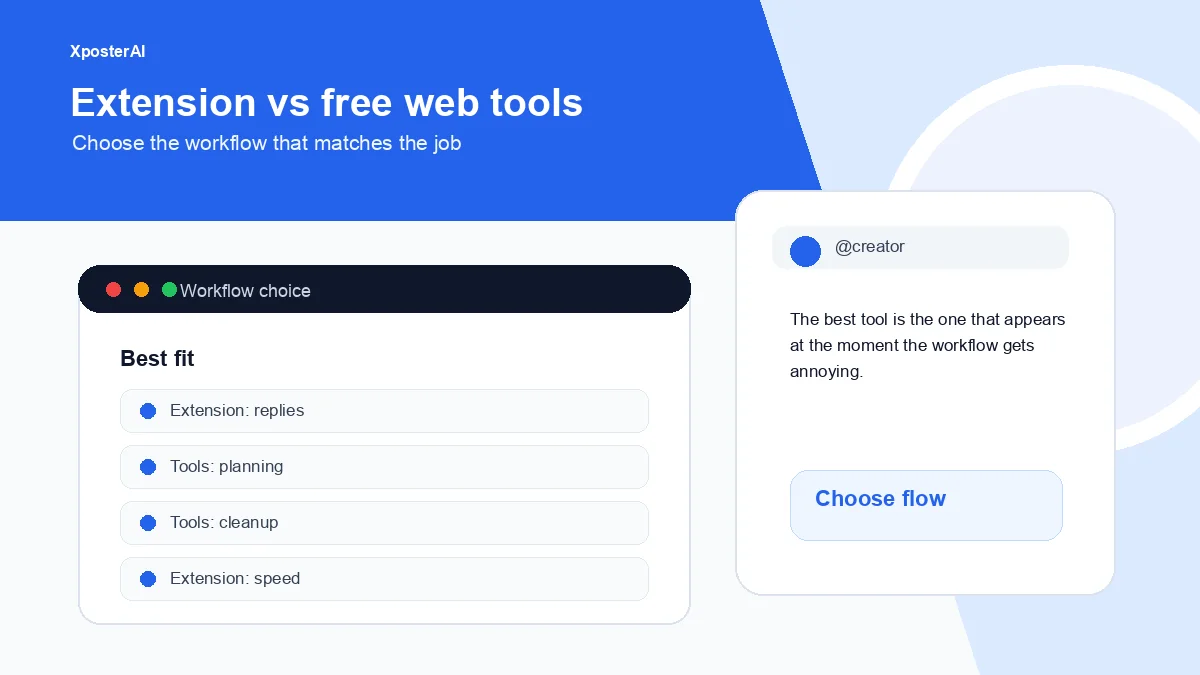
- The XposterAI Chrome extension puts all of that inline in the X compose box. That's where 70/30 becomes sustainable — friction per reply drops to seconds.
For the deeper technique, read How to write better X replies with AI and the X reply checklist before you hit reply. For the tooling tradeoff, ChatGPT vs a dedicated X reply generator covers it.
Before and after: a flat reply vs a compounding one
Original post: "Most founders underestimate how long it takes to find a real wedge in the market."
Flat reply: "So true. Wedge-finding is the hardest part of building."
That gets a like if you're lucky and is invisible to the algorithm by morning.
Compounding reply: "Took us 14 months on our last product before we found the wedge — and the version that worked was almost the opposite of the original pitch. The signal was watching which support tickets came in repeatedly. What were you looking at when yours clicked?"
Specific timeframe, concrete signal source, ends on a question that pulls the original poster back into the thread. Same situation, maybe 20 seconds more effort, completely different outcome.
FAQ
How many replies per day, realistically?
4-8 substantive replies beats 20 throwaway ones. Quality is what the ranker rewards. If you can only do three, do three good ones.
What about big accounts that never reply back?
They don't need to. The reach you get is from their followers, not from them. Some creators have reported scaling their accounts noticeably by reply-farming five big accounts in their niche for six to twelve months without a single reply-back from the host. The mid-sized accounts are where the relationships actually form.
Does this work in any niche?
It works wherever there's an active conversation. Niches with very few public accounts (some B2B verticals, regulated industries) make it harder — the target list runs thin. In those cases, you blend 70/30 with more original posting because the warm-reach lever is just weaker.
Is AI-assisted reply safe?
Yes, if you edit. The risk isn't AI assistance — it's posting unedited AI output that hits the demoted patterns above. A draft from a reply tool that you trim, personalize, and run through an audit is functionally the same as a draft you wrote yourself and tightened. The tooling is fine; lazy posting is what gets penalized.