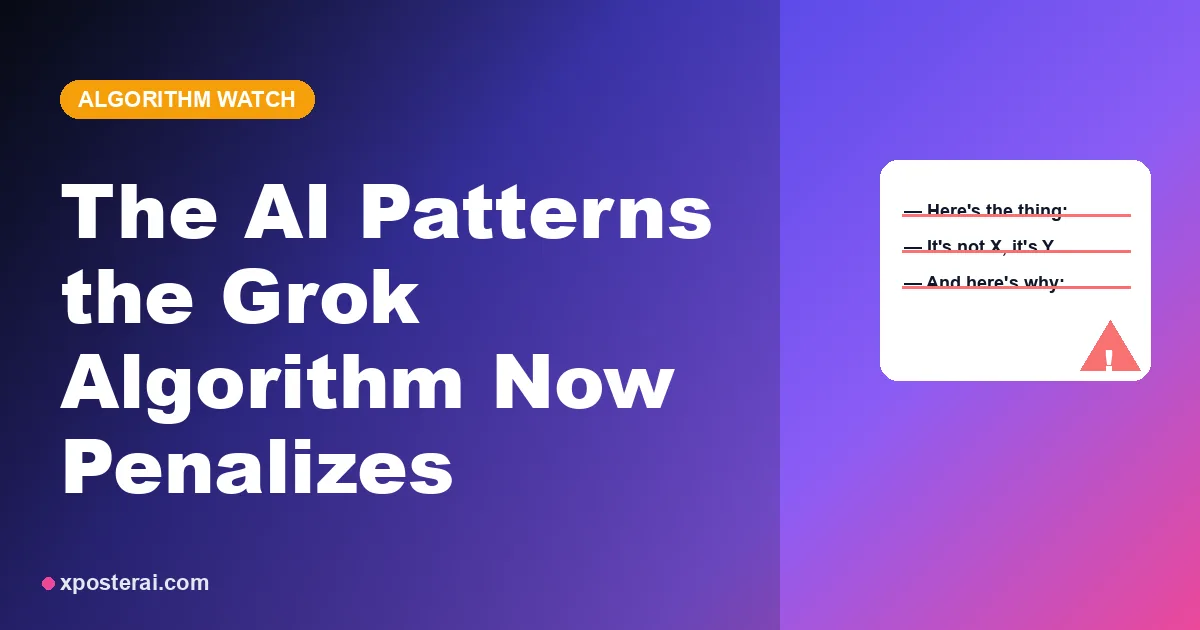
Your tweet wasn't bad. It just looked like a tweet a language model would write.
That is the new failure mode on X. According to public reporting on X's algorithm shift in January 2026, the Grok-powered ranker replaced large parts of the legacy timeline scorer, and creators are now whispering about reach throttling on posts that pattern-match to LLM output. The post still appears. It just stops travelling. You see flat impressions, blame the topic, and try again with another LLM-shaped draft.
The model is good at recognising its own family of outputs. It was trained on them. A post lightly edited from ChatGPT, Claude, or Grok itself often carries fingerprints the ranker can pick up even when a human reader would not notice.
The fix is almost always stylistic, not topical. Most posts can be de-AI-ified in under a minute once you know what to look for.
The 9 giveaways, in one list
Save this and audit your drafts against it.
- Em-dashes used as conversational beats
- Perfectly parallel three-item lists in every paragraph
- The "it is not X, it is Y" framing
- Generic curiosity openers like "Here's the thing" and "Here's what nobody tells you"
- The seven-tweet thread template with header-style bullets
- The "I tested X so you don't have to" hook
- Smart curly quotes and curly apostrophes where humans type straight ones
- Title-case headings dropped inside a tweet body
- Word-count-perfect parallel sentence pairs
Now the why and the fix for each.
1. Em-dashes used as conversational beats
Example: "Most creators — and I mean most — fail at hooks because they think — incorrectly — that more words equals more value."
The dash itself is fine. Three em-dashes in a short post, used as breath marks instead of as real interruptions, is a strong tell. Almost nobody types an em-dash on a phone keyboard, and the ones who do usually use one per post, not three.
30-second fix: delete two of the three dashes and replace with a period or comma. Keep one if the sentence actually needs the interruption.
2. Perfectly parallel three-item lists in every paragraph
Example: "Write clearly, post consistently, and reply generously."
The first time you do this, it reads sharp. The fourth time in 280 characters, it reads templated.
30-second fix: break one of the three items. Make it longer than the others, or drop one. "Write clearly. Post often. Replies are where the relationships actually happen" reads human because the third beat refuses to match.
3. The "it is not X, it is Y" framing
Example: "Your problem isn't reach. It's resonance."
This construction produces a satisfying turn in one breath, which is why models reach for it constantly. Real people use it occasionally.
30-second fix: drop the contrast. "Reach is fine. What you actually want is for the right twelve people to care" makes the point without the rhetorical seesaw.
4. Generic curiosity openers
Examples: "Here's the thing." "Here's what nobody tells you." "Most people get this wrong." "The truth is."
Filler. They promise a payoff without delivering one in the same line.
30-second fix: delete the opener. Start with the claim. If the second sentence still works as the first, the opener was carrying nothing.
5. The seven-tweet thread with header-style bullets
You know the shape. Tweet 1 is the hook. Tweets 2 through 6 each start with a bold-looking emoji or number, a colon, then one parallel sentence. Tweet 7 is a CTA to follow. This format was a craft once. Now it is the default output of every "write me a thread" prompt.
30-second fix: break the template. Make tweet 3 a single sentence. Skip the numbering. Let one tweet be a screenshot instead of text. The shape is the giveaway more than the words.
6. The "I tested X so you don't have to" hook
Example: "I tested 47 AI writing tools for 90 days. Here are the 5 that actually work."
Specific, numbered, sacrificial. Scans as research-as-content. Also the most overused hook template of the last two years.
30-second fix: drop the round number and the "so you don't have to" frame. "I have been paying for three writing tools for a year. Only one survived the renewal" is the same idea told like a person remembering instead of a model performing.
7. Smart curly quotes and curly apostrophes
The X compose box does not auto-curl punctuation. macOS does. So does Google Docs. So does every LLM output stream. Curly quotes mean you pasted from somewhere.
30-second fix: find-and-replace curly to straight, or paste through a plain-text intermediate. The difference is invisible to a casual reader and obvious to a classifier.
8. Title-case headings inside a tweet body
Example: A tweet that starts with "The Three Mistakes New Creators Make:" then a list.
Real people do not capitalise every word in the middle of a casual post. Blog headlines do. LLMs trained on blog headlines do.
30-second fix: sentence case. "Three mistakes new creators make" reads like a person. The title-case version reads like an H2.
9. Word-count-perfect parallel sentence pairs
Example: "Hooks get clicks. Substance gets follows."
Lovely. Also seven syllables on each side, same grammar, same rhythm. Humans write it occasionally. Models write it three times per post.
30-second fix: let one side be longer or messier. "Hooks get clicks. Substance is what gets someone to stay around for the next twelve posts" keeps the contrast and loses the templated cadence.
Before and after
A draft that pattern-matches to LLM output, top to bottom:
Here's the thing about growing on X in 2026 — it's not about volume, it's about voice. I tested 30 AI tools so you didn't have to, and the truth is: most are noise. Write clearly, post consistently, reply generously. The Three Habits That Actually Move The Needle.
That post hits eight of the nine giveaways in 60 words. Now the same idea, four edits later:
I have been paying for AI writing tools since 2023. Most of them write fine sentences that nobody wants to read. The ones I kept are the ones that let me sound like myself on a tired Tuesday, not like a brand on launch day.
Same opinion. None of the template.
A 30-second post-AI workflow
If you draft with an LLM and want the post to survive the ranker, three passes:
First, strip the nine patterns above by hand. Faster than it sounds once you have done it twice.
Second, paste the cleaned draft into the Tone Rewriter and ask for a casual register. Casual outputs carry fewer formal-LLM tells than "professional" or "witty" ones, because casual rewrites break parallelism on purpose.
Third, run the result through the Tweet Hook Analyzer to make sure the first line still earns the rest of the post. Stripping AI tells sometimes removes the hook by accident.
For replies, same patterns at smaller scale. The Reply Audit catches generic LLM-shaped replies before you burn a chance at a real conversation with someone bigger than you.
A note on the XposterAI extension
The reply generator inside the XposterAI Chrome extension is tuned to avoid most of the nine patterns by default. It will not hand you "Here's the thing" openers, it will not curl your quotes, and it will not output the seven-tweet thread template. You still want a human read on the output, but the cleanup pass on patterns 1, 4, 7, and 8 mostly skips itself.
For more on tone-shifting without losing your point of view, rewrite-tweet-tone-without-losing-voice covers the guardrails. To rule out shape issues before blaming the algorithm, why-tweets-look-weak-after-posting is the place to start. For hooks that work without the templated cadence, write-tweet-hooks-without-clickbait goes deeper.
FAQ
Does this apply to replies too, or just original posts?
Replies appear to be affected, though the throttle is harder to see because replies live inside a conversation rather than the for-you ranker. Creators report that replies which should have surfaced under a popular post stop showing up for the OP's other followers. Same fix: strip the patterns, then post.
Can I still use AI to draft posts at all?
Yes. The penalty is on output that still looks like a model wrote it, not on the act of using one. A post that started in Claude and was edited until none of the nine giveaways remained behaves like a hand-typed post, as far as anyone outside X has been able to observe. The work is in the editing pass.
What about Grok itself, does it produce the same patterns?
Grok produces the same family of patterns with slightly different defaults. The ranker does not appear biased toward its own output. If anything, Grok output is the most recognisable to Grok, because it is closest to the training distribution the ranker was tuned on.
How do I know my reach was actually throttled and not just a bad post?
You usually cannot, in isolation. The signal is pattern over time. If three or four posts in a row that match the nine-giveaway profile underperform your usual floor while stylistically different posts on similar topics do not, treat it as a stylistic problem. One flat post is just a flat post.