Tone tools are useful until they sand off the point of view.
That is the risk with AI rewriting. "Professional" becomes bland. "Witty" becomes forced. "Sharp" becomes rude. The post changes tone, but it also stops sounding like someone with judgment.
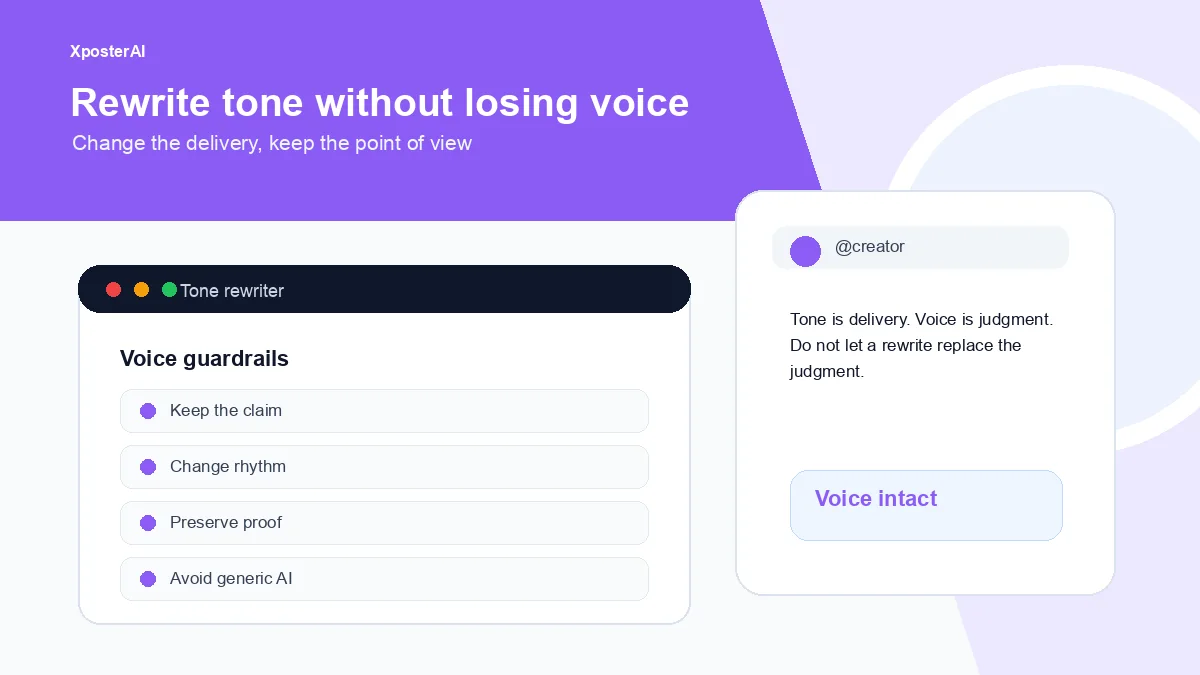
The fix is small and stubborn: preserve the claim, the proof, and the point of view. Change the rhythm, the word choice, and the edge. The Twitter Tone Rewriter can produce variants, but the original judgment is yours to protect. If you have trained Persona Studio, the rewrite will land closer to your natural cadence on the first try.
Voice is not tone
Voice is what you notice, believe, prioritize, and refuse to say.
Tone is delivery.
You can say the same thing warmly, sharply, casually, or professionally. But if the rewrite changes the claim, it is no longer a tone change. It is a new opinion — usually a softer, blander one that the model thought was safer.
One claim, four tones
Original: Most creators do not need more content ideas. They need a clearer reason for people to follow.
Professional: Content volume helps, but profile clarity usually decides whether a visitor becomes a follower.
Witty: More post ideas will not save a profile that answers zero visitor questions.
Sharp: If your bio is vague, a bigger content calendar just sends more people to a confusing door.
Same idea. Different delivery. Notice that none of the rewrites drop the claim that volume is not the bottleneck — that is the load-bearing opinion.
What to lock before rewriting
Before pasting anything into a tone tool, write down three things:
- The claim that must stay true.
- The example or proof that makes it credible.
- The line you would never say.
That last one matters most. It protects your taste. I keep a short list pinned in a note app — phrases like "game-changer," "let that sink in," and any sentence that ends with a single fire emoji. When a rewrite hands one of those back to me, I throw the whole variant out instead of editing around it.
Rewrite with guardrails
Use the Twitter Tone Rewriter for variants. If you want outputs closer to your real voice, train Persona Studio and read Persona Studio: Train Your Voice Into XposterAI. For reply-specific writing, use Reply Audit.
FAQ
What is the difference between tone and voice?
Voice is your perspective. Tone is how that perspective sounds in a specific post.
Can AI preserve my voice?
Partly. The model is good at matching surface cadence — sentence length, contractions, whether you use em dashes. It is worse at preserving the load-bearing opinion when that opinion is mildly contrarian, because the safety-tuned defaults pull every rewrite toward "balanced." You still have to edit the variant for judgment and accuracy.
Which tone works best on X?
The tone that fits the topic, audience, and account promise. Witty is not automatically better than clear.