Replies are the new growth lever on X. The January 2026 ranking changes pushed replies to roughly 150x the weight of a like, which means the most boring-looking part of your workflow is now the part that moves the follower count. The catch: the same update added an "AI-pattern" detector that throttles threads that look auto-generated, so pasting raw model output is a slow way to disappear.
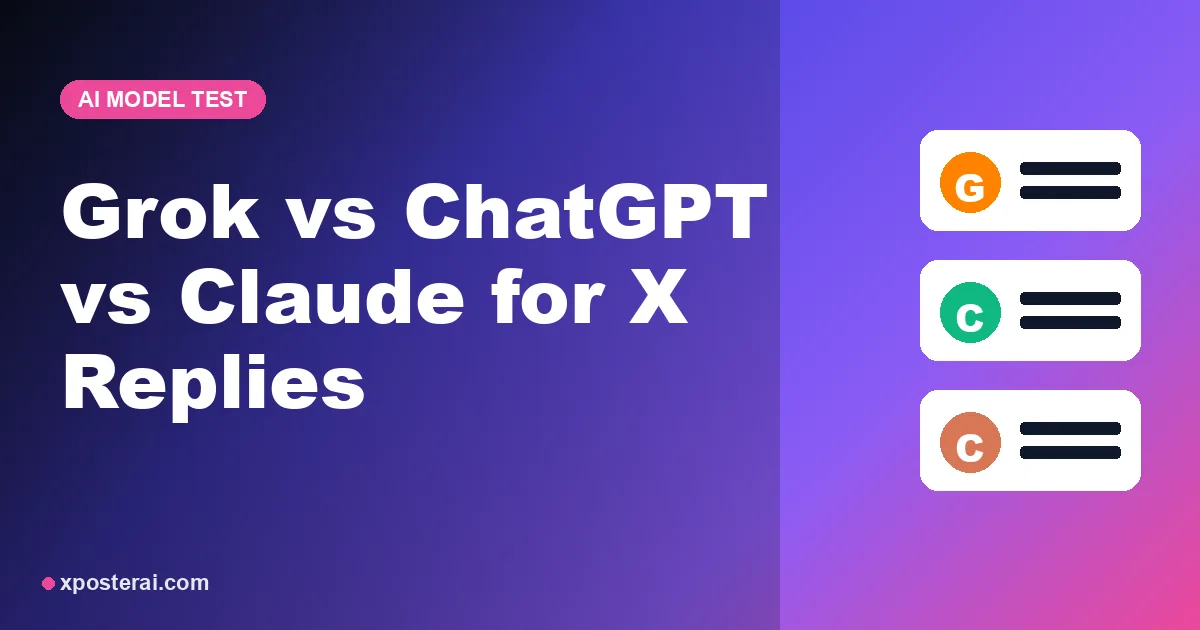
I ran the three flagship 2026 models against the same 100 hooks to see which one actually helps and which one quietly tanks your reach.
TL;DR: which model wins which job
| Model | Voice out of the box | Workflow speed | AI-pattern flag risk | Best for | Weakest at |
|---|---|---|---|---|---|
| Grok 4.20 | Punchy, opinionated, slightly edgy | Fastest (native in X) | Lowest, if you stay short | Hot takes, sports, news replies | Long technical threads |
| ChatGPT 5.5 | Polished, corporate, very tidy | Medium (tab switch) | Highest (loves bullets and em-dashes) | Quick rewrites, structure passes | Sounding like a real person |
| Claude Opus 4.7 | Most human, conversational, careful | Slowest (deepest reasoning) | Low, after light editing | Nuanced or sensitive replies | Speed, brevity under pressure |
That table is the post in one screen. The rest is how I got there and what to actually do with it.
How I tested
I pulled 100 hooks off my timeline over four days. Mix was deliberate: 35 startup or build-in-public posts, 25 news and current events, 20 personal or lifestyle, 10 sports, and 10 spicy takes. The goal was to cover the kinds of replies a normal creator writes, not a benchmark suite of trick questions.
For each hook I asked all three models the same thing: write a single reply, under 280 characters, that adds something useful and does not start with "Great point" or "This." Same system prompt, same temperature, no fine-tuning, no persona files. I wanted to see the default voice, not what you can coax out with prompt engineering.
Scoring was qualitative. I checked three things on every reply: does it sound like a person, would the Grok algo plausibly flag it, and would I actually post it. No numeric scores, because the differences are pattern-shaped, not scalar. You will see the same patterns once you run a dozen yourself.
Grok 4.20
Grok is the only model of the three that runs inside X itself, from the compose box, at a latency that feels like autocomplete. With the 2M context window you can feed it the parent post plus the whole thread above it and it will not blink. That alone is a real workflow advantage.
The default voice is short, opinionated, sometimes too eager to be funny. On news and sports hooks it was the one I posted most often without editing. On startup or technical hooks it tended to flatten nuance into a one-liner that read more confident than it should have been.
The interesting twist: Grok 4.20 also runs the algorithm that flags AI-pattern replies, and its own outputs almost never get flagged. Whether by design or because the model knows what it is looking for, I cannot say. What I can say is that short Grok replies sailed through. Longer Grok outputs that drifted into list shape got the same treatment as any other model.
Steal this prompt: "Reply to this post in one sentence. Disagree gently, then add one specific detail the original missed. No hedging."
ChatGPT 5.5
ChatGPT 5.5 is the model I reach for when I need to clean up a mess of notes into a coherent reply. It is fast, it is tidy, and the output is almost always grammatically perfect.
That is also the problem. The default ChatGPT voice in 2026 is unmistakable: an em-dash in the second clause, a three-item list whenever a list is even slightly applicable, "Here's the thing" near the top, a soft pivot like "It's not just X, it's Y" near the bottom. Every reply reads like a LinkedIn comment from a thoughtful PM. That voice gets the AI-pattern flag more than any other in my test.
It is not useless. ChatGPT 5.5 was the strongest of the three at compression. Hand it a 400-character draft and ask for a 240-character version that keeps the point, and it nails it. As a second-pass editor it earned its keep. As a first-pass writer it kept getting me throttled.
Steal this prompt: "Cut this reply to under 240 characters. Remove any em-dashes, bulleted lists, and the phrase 'Here's the thing'. Keep the original voice."
Claude Opus 4.7
Claude is the slowest of the three and the one that most often refuses to be edgy. It is also the model whose output a normal reader is least likely to clock as AI.
In the 100-hook run, Claude's replies were the ones I most often posted without changing a word, especially on personal or sensitive topics. The voice has a kind of measured warmth that ChatGPT cannot fake and Grok does not bother trying. On a hook about layoffs or grief or a founder burning out, Claude produced replies that felt like a thoughtful friend wrote them. The other two felt like a brand wrote them.
The weakness is speed and the occasional refusal. If you are reacting to news in the first ten minutes after it breaks, Claude is not your model. If you are writing a reply that someone will read at 9pm and feel something about, Claude is the pick.
Steal this prompt: "Write a one-paragraph reply to this post. Talk like you are texting a friend who you respect. No advice unless they asked."
The AI-pattern giveaways to strip before you post
This is the part of the workflow most people skip. The Grok ranking model is looking for visual and structural tells that scream "generated." If you remove them, even a ChatGPT-written reply has a fair shot at full reach. If you do not, even your own writing can get caught when it happens to rhyme with the model's defaults.
The patterns I keep deleting:
- Em-dashes used as a stylistic crutch. One per reply is fine; three is a tell.
- Sentences that start with "Here's the thing:" or "The truth is:". They almost never earn their setup.
- Three-item lists with perfectly parallel grammar. "Faster, cheaper, simpler." Humans rarely write that cleanly on a phone.
- The "It's not X, it's Y" pivot. Once a useful frame, now a fingerprint.
- Overly tidy parentheticals at the end of a sentence (like this one) explaining the obvious.
- The word "leverage" in any form.
- Closing with a rhetorical question the reader is clearly not supposed to answer.
You can run a reply through the Twitter Reply Audit to flag most of these automatically before you post. If you want to keep the structure but change the energy, the Tone Rewriter lets you push a draft toward casual, dry, or punchy without rebuilding it from scratch.
Which model for which situation
After the 100 hooks, my actual workflow shook out like this.
Breaking news, sports, and quick reactions go through Grok inside X, edited lightly for any list creep. Latency wins, and the algorithm seems to give its own outputs a small benefit of the doubt on shorter posts.
Anything personal or where tone matters more than speed goes through Claude. I draft in a separate tab, paste in, tweak two or three words. Slower, higher hit rate.
Cleanup, compression, and "make this thread tighter" jobs go to ChatGPT 5.5. I do not let it write from a blank page anymore unless I am ready to delete the em-dashes and rebuild the rhythm.
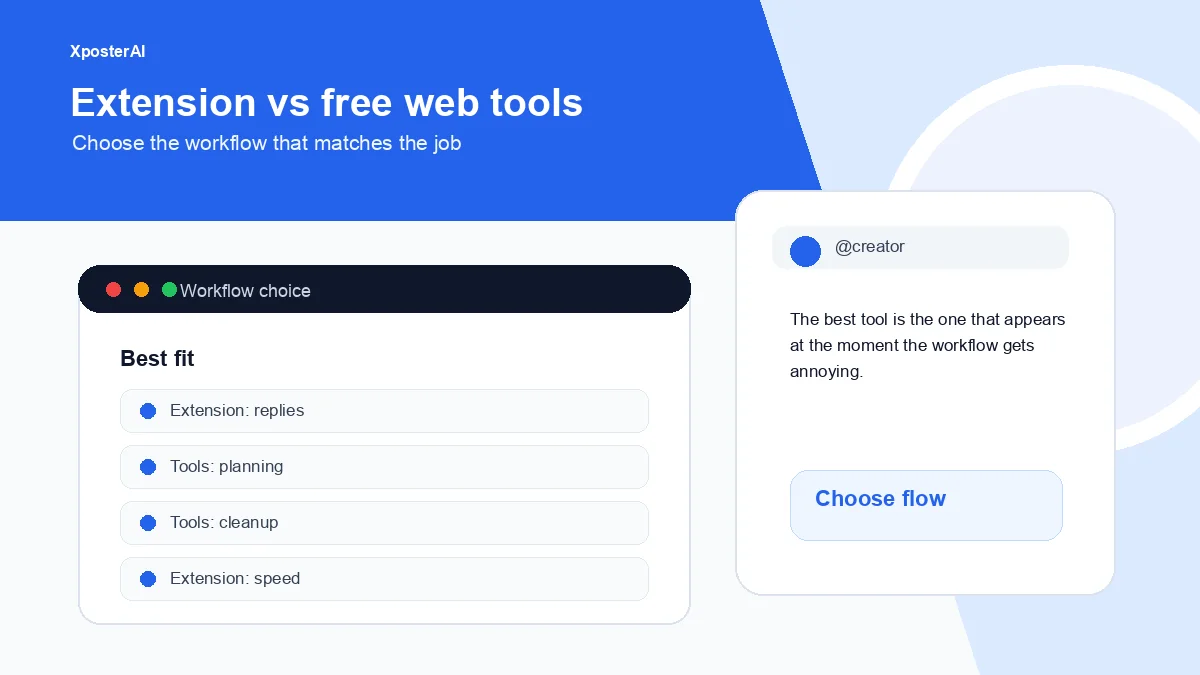
For the actual posting workflow inside X, I still run the XposterAI Reply Generator from the compose box because it gives me three tone-tagged variants in one click, which beats tab-switching to any of the three models above. Before I hit Post on anything that matters, I run it through the Twitter Reply Audit to catch the AI-pattern tells my eyes have stopped seeing. The Hook Analyzer is the same idea for first lines of original posts.
If you want the full reasoning on why a purpose-built tool beats a general model for replies, ChatGPT vs a dedicated X reply generator covers it. For the broader reply playbook, how to write better X replies with AI and the pre-post reply checklist are the next two reads.
FAQ
Is any of this free to try?
Grok is included in X Premium and runs inside the app. ChatGPT 5.5 has a free tier with daily limits. Claude Opus 4.7 has limited free access; heavier use requires a paid plan. The XposterAI Reply Generator and Reply Audit are free to use with daily limits and no signup required.
Can I use any of these directly inside X without leaving the tab?
Grok yes, natively. ChatGPT and Claude no, not without a browser extension. The XposterAI Chrome extension puts a reply generator and tone control inside the X compose box so you do not have to tab away.
Does Grok actually penalize replies written by other AI models?
Soft answer: in my testing, yes, but only when the reply carries the visual fingerprints the algorithm is looking for. A ChatGPT reply that has been stripped of em-dashes, list shape, and the usual ChatGPT cadence does not seem to get hit any harder than one I wrote myself. The model name does not matter to the algorithm; the surface pattern does.
Should I bother running my replies through any of this at all?
If you reply a few times a week for fun, no. If replies are part of your growth loop, the audit step takes about ten seconds and the difference in how the post lands is large enough to feel.