Most threads don't lose readers at the first tweet. They lose them between tweets.
The opener earns attention. The transition earns the next tap. If every tweet ends flat, the thread quietly leaks readers even when the information is good — and you won't see it in the analytics, because impressions on tweet 4 just look like "fewer impressions on tweet 4."
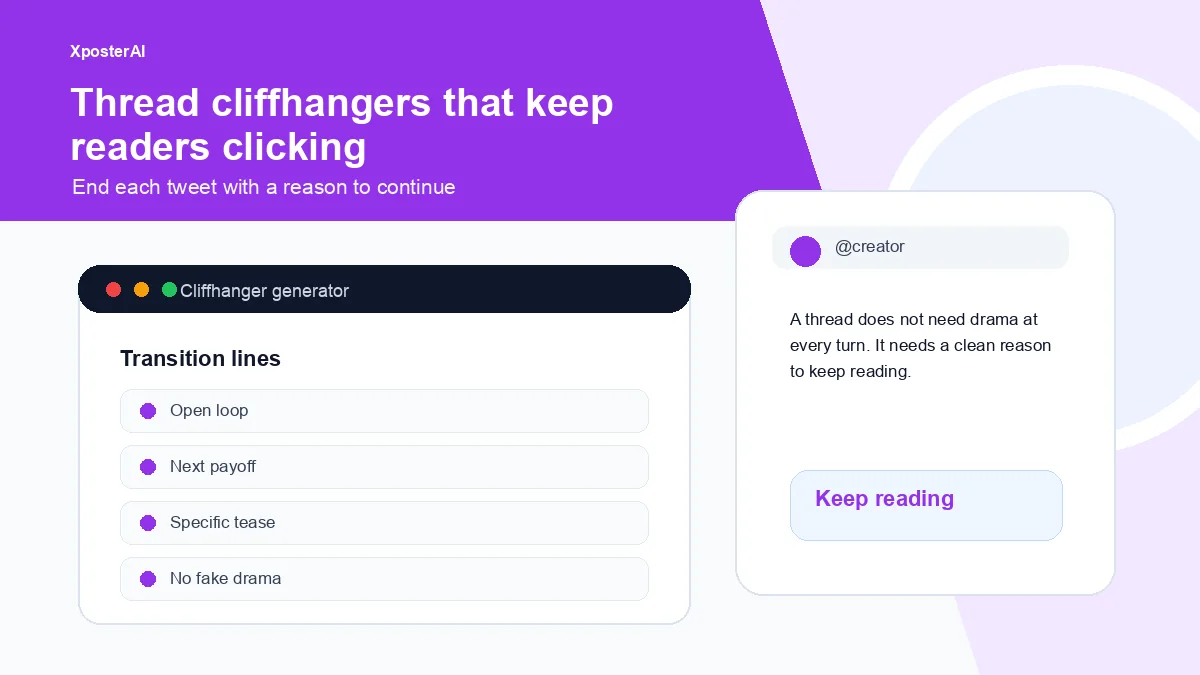
End each tweet with a reason to continue: a consequence, contrast, proof tease, next step, or mistake. A good cliffhanger doesn't fake suspense. It honestly previews the value in the next tweet. The Thread Cliffhanger Generator helps you add those transitions after the draft already exists, which is the right order — write the substance first, then layer the connective tissue.
Five transition types that work
Consequence: "That is where the leak starts."
Contrast: "But the visible problem is not the real one."
Proof: "You can see the pattern in three places."
Method: "Here is the check I use before posting."
Mistake: "This is the part most creators fix too late."
These lines work because they point forward. They do not just say "continued below."
Before and after
Flat: Here are three examples.
Better: The third example is the one most profiles get wrong.
Flat: This is why formatting matters.
Better: The formatting problem usually starts before the post is written.
Flat: Now let's talk about tools.
Better: You only need a tool after you know which part of the workflow is broken.
The pattern: the flat version describes what comes next. The better version makes you slightly need it.
When not to use a cliffhanger
Don't add suspense where the next tweet is just another list item. Don't end every tweet with a dramatic line. Don't promise a payoff the next tweet cannot deliver — that's the move that turns a thread into clickbait, and readers notice by tweet 3.
The best transition is often quiet. It gives the reader orientation, not adrenaline.
I went back through a thread of mine that died at tweet 6 — saw it on analytics days later. The culprit was tweet 5: I'd ended on "Now for the fix." Generic, no specificity, no reason to tap. I rewrote it as "The fix is one line, and it's in the wrong file." Different thread, same fix, very different drop-off shape.
Add transitions after the draft
Draft the thread with the Thread Outline Builder, split it with the Twitter Thread Splitter, then improve transitions with the Thread Cliffhanger Generator. If you're still learning structure, start with how to write a Twitter thread outline.
FAQ
Are cliffhangers clickbait?
They become clickbait the moment the next tweet doesn't deliver. "You won't believe what happened next" followed by a list of obvious tips is clickbait. "The fix is one line, and it's in the wrong file" followed by an actual one-line fix in an actual wrong file is just good structure. The honesty of the transition is what separates the two.
Where should I add them?
Between major sections, before examples, before proof, and before the practical fix. Not after every single tweet — that's exhausting and trains the reader to tune out.