Most content calendars are built for a fake week.
In the fake week, you have perfect energy, clean ideas, no client calls, no bugs, no errands, no half-finished launch work. In the real week, the calendar collapses by Wednesday and becomes another document you avoid opening.
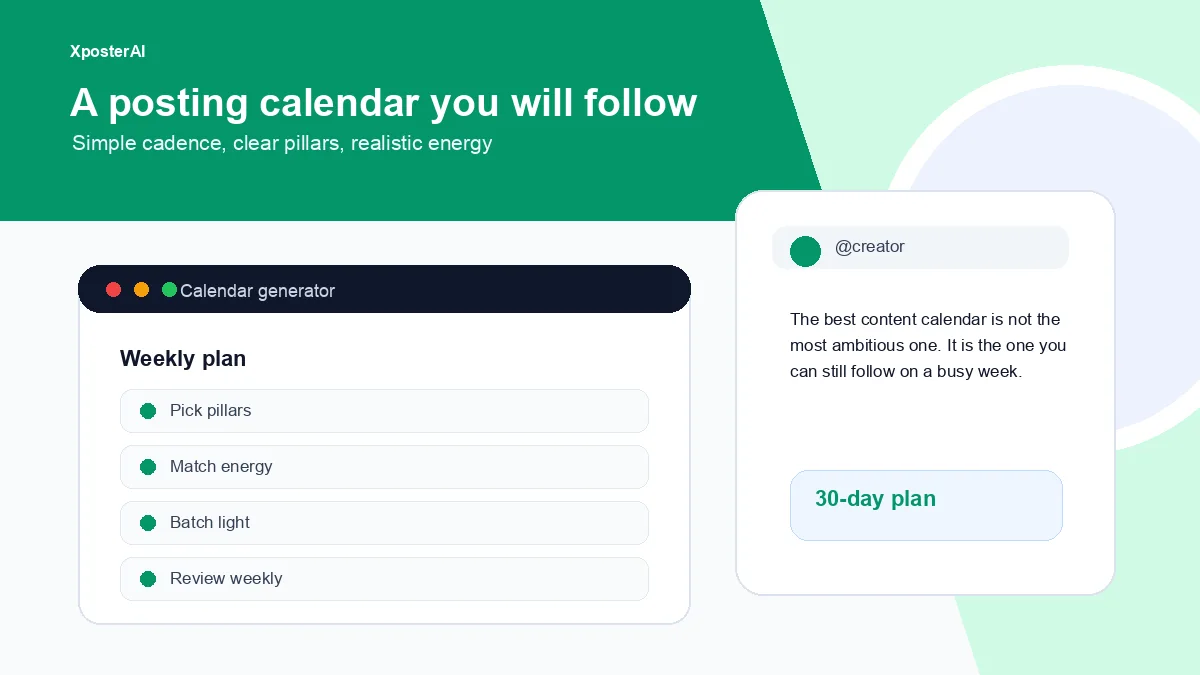
A useful calendar starts with constraints, not aspiration. Three content pillars, two repeatable formats, one weekly review habit. Generate a first draft with the Posting Calendar Generator, then simplify it until you could follow it on the worst week of your quarter — because that's the week the calendar has to survive.
The 3-2-1 calendar
Three pillars: the topics you want to be known for.
Two formats: repeatable shapes you can write without starting from zero.
One review: a weekly look at what worked, what felt heavy, and what deserves a second version.
Example:
- Pillars: profile conversion, better replies, creator tools.
- Formats: teardown and checklist.
- Review: Friday, 20 minutes.
That is enough structure to move without building a content bureaucracy.
A realistic week
Monday: lesson learned.
Tuesday: reply sprint.
Wednesday: tool or template.
Thursday: teardown.
Friday: weekly proof, experiment, or recap.
Weekend: optional repost with credit or archive review.
Each day has a job. That is why it works better than a blank box labeled "post."
What breaks calendars
Too many unique post types — every slot demanding fresh creative.
No idea capture system, so Monday morning starts from a blank page.
No room for live conversations, so you skip the trending thread your audience is in.
No review habit, so the same dud format keeps appearing for weeks.
Scheduling posts without checking whether the profile, pinned post, and links are ready for the traffic.
I've watched myself burn out on calendars about four times over the last few years, and the failure mode was always the same one: I designed for a version of me who didn't have a day job. The 3-2-1 came out of asking what would still be doable in a week where I had two product launches and a cold.
Build the first calendar draft
Use the Posting Calendar Generator for the first plan, the Best Time to Post on X tool for initial windows, and 30-day X content calendar for creators when you need examples. If you want a broader system, read A Practical Social Media Content Planning Template.
If you run the calendar inside XposterAI, Scheduler Studio's Autopilot attacks the worst-week problem directly: it scans your week for empty slots and writes drafts into an approval tray at your best times. It never posts anything by itself — you approve every word — but Monday starts from a draft to edit instead of a blank box, which is usually the difference between a calendar that survives and one you avoid opening.
FAQ
How many times should I post each week?
Pick a cadence you can sustain on a bad week, not a good one. For most solo creators that's three to five real posts plus regular replies — and that beats an unrealistic daily schedule that you'll quietly abandon by week three and then feel guilty about for a month.
Should I plan 30 days at once?
Plan 30 days as a map, then review weekly. Leave room for fresh ideas — the post that actually catches will almost always be one you wrote that morning, not one you locked in three weeks ago.
What is a content pillar?
A recurring problem, belief, workflow, or audience outcome you want the account to own.