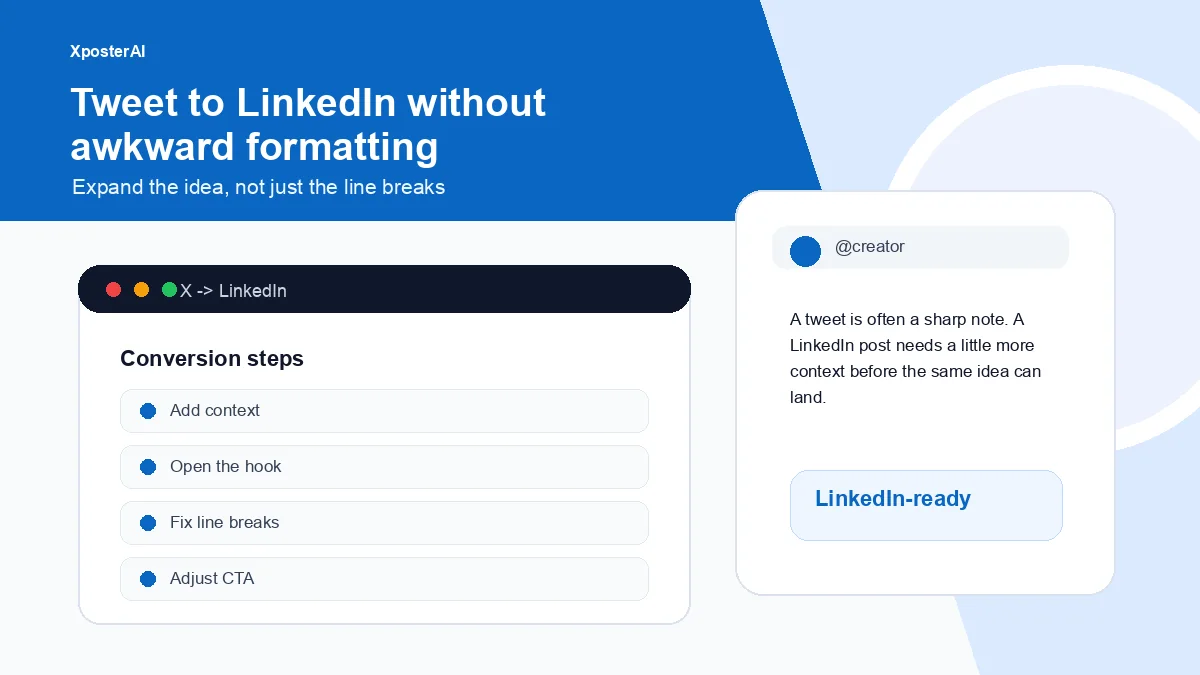
A tweet is often a sharp note. A LinkedIn post usually needs a little more room to breathe.
That is why copy-paste cross-posting feels awkward. The idea may be good, but the shape is wrong. X rewards compression. LinkedIn usually needs context, paragraph rhythm, and a softer landing.
What I actually recommend
Keep the core insight, but expand the setup, add one example, fix the line breaks, and adjust the CTA. The Tweet to LinkedIn Converter gives you a first pass, and the Social Post Line Break Formatter cleans the final version. The order matters — convert first, then format. Formatting a draft that is still tweet-shaped just produces a tweet with more whitespace.
What changes between X and LinkedIn
On X, a strong post can start in the middle of the thought.
On LinkedIn, that same move can feel abrupt. Readers often need one more sentence explaining why the point matters, especially if the post is not attached to a larger conversation. The LinkedIn feed surfaces a post hours or days after it is written, often to people who have never seen your other work. The X feed shows it inside a conversation that is already happening.
| X version needs | LinkedIn version often needs |
|---|---|
| Sharp hook | Slightly expanded hook |
| Compressed context | One setup paragraph |
| Fast punchline | Example or implication |
| Casual CTA | More specific next step |
Example conversion
Tweet:
Your bio should not describe you. It should help the right person decide whether to follow.
LinkedIn version:
A lot of founders write bios like resumes.
The problem is that a profile visitor is not hiring you yet. They are deciding whether your posts are worth seeing again.
A stronger bio answers four questions quickly:
- Who is this for?
- What will I learn?
- Why should I trust them?
- What should I click next?
That is not branding polish. It is conversion hygiene.
Same idea. Better platform fit. The LinkedIn version is roughly four times longer, but the load-bearing claim is one sentence longer — everything else is setup and structure.
What not to do
Do not just add blank lines to a tweet and call it a LinkedIn post.
Do not keep X-native phrases that feel strange on LinkedIn. "Banger of a thread" reads as in-joke energy in one feed and as cosplay in the other.
Do not turn every concise thought into a long essay.
Do not keep a CTA that only makes sense on X, like "reply below," if the LinkedIn audience needs a different next step.
Convert the shape, not just the text
Use the Tweet to LinkedIn Converter for the first adaptation. Use the line break formatter for final spacing. If your formatting keeps breaking between platforms, read why LinkedIn formatting breaks when cross-posting from X.
FAQ
Can I repost tweets on LinkedIn?
Yes, but adapt the format. Add context, clean spacing, and adjust the CTA for LinkedIn.
Should LinkedIn posts be longer?
Usually, but the goal is not length — it is completeness. A LinkedIn reader should be able to understand the point without having seen the original tweet, the surrounding thread, or your other recent posts. Sometimes that takes 60 words and sometimes it takes 300. The wrong move is padding a short idea to hit some imagined LinkedIn minimum.
What breaks most often?
Line breaks, compressed context, casual CTAs, and hooks that assume the reader saw the original conversation.